Wednesday, May 30, 2018

Strengthen Your Portfolio With This Antifragile Stock

In a previous article, I gave an overview of three companies that benefit from increased volatility: Virtu (VIRT), Flow Traders (OTC:FLTDF) and ABC Arbitrage (ABCA:FP).

This follow-up is dedicated to ABC Arbitrage, a small-cap foreign stock which presents some interesting characteristics for investors looking to diversify their portfolios and sleep well at night during a recession.

What is "antifragile"?

The concept of antifragility was developed by Nicholas Nassim Taleb in his book Antifragile. When submitted to stress, an object will usually either be harmed, or withstand the shock. But there exists a third possibility: that the object will actually benefit from being stressed.

This possibility has traditionally been underestimated, to the extent that no adjective exists in the main languages to characterize the concept. That��s why Taleb created the neologism ��antifragile�� to qualify things that gain from stress and disorder.

Nature provides many examples of anti-fragility. The human body itself is - up to a certain point - antifragile: a workout will stress your muscles and contribute to make them stronger. Human life can display elements of antifragility, as in Nietzsche��s famous line: ��what does not kill me makes me stronger.��

In the field of investments, companies get stressed in a recession. Some suffer from it, others (e.g. consumer staples) show some resilience, and a very small number of companies actually benefit. ABC Arbitrage is one such antifragile company.

ABC Arbitrage��s operations

ABC arbitrage was founded in 1995 and is headquartered in Paris, France, with offices in Paris, Dublin and Singapore. It does not trade on North-American exchanges, but most brokers should be able to provide access to Euronext (SBF exchange) where the stock is listed. ABC Arbitrage has a market capitalization of ��400m at current share price of ��6.9.

As the name indicates, the company is specialized in arbitrage opportunities in financial markets, such as:

Liquidity arbitrage: detecting and correcting differences in trading prices between linked assets. Risk arbitrage: taking advantage of risk mispricing in capital markets. Statistical arbitrage: pair-trading within an industry, lead-lag effects (e.g. interaction between commodity prices and inflation). Derivatives arbitrage: detecting mispricing in options and other derivatives.

(Source: company��s website)

To seize such arbitrage opportunities in financial markets across the world, ABC Arbitrage relies on proprietary algorithms. Unsurprisingly, the workforce is predominantly made of engineers and finance specialists.

ABC Arbitrage manages both its own funds and external funds. As a result, the company has two sources of income: trading revenue from its proprietary trading, and fees charged to external clients.

ABC Arbitrage is almost a pure play on volatility

ABC Arbitrage displays its antifragile characteristics in volatile markets. The more stress, the more mispriced assets that the company can take advantage of. In this recent interview (in French), CEO Dominique Ceolin confirmed that volatility remains the main factor explaining the company��s performance, to the extent that shareholders can predict future results by following the VIX (or the VIX-tracking VXX).

Unsurprisingly, 2017, especially the second semester which was marked by record-low volatility, was a challenging period for ABC Arbitrage. Trading revenue (included within ��net gains at fair value�� below) took a hit, and investment services revenue suffered, to a lesser extent.
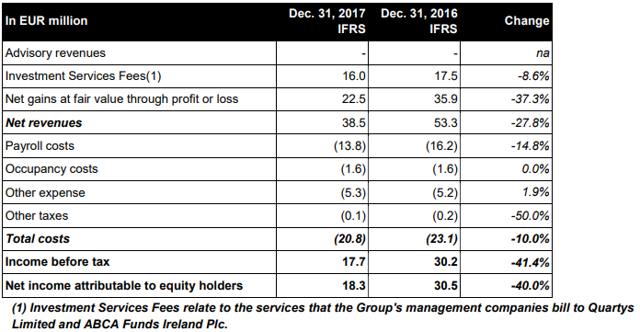
ABC Arbitrage P&L 2017

(Source: company��s 2017 annual report)

Despite these ��crash-test�� conditions, the company still managed to turn an ��18.3m profit equating to a ROE of 11.5%, achieved with no leverage as the company is debt free. The decrease in payroll costs results from the substantial variable component of employees�� remuneration (30%). It does not come from cost cutting - I consider this a good thing as the company takes a long-term view. Its focus is on developing new algorithms tailored for low-volatility environments, as part of a ��Step Up 2019�� plan announced in 2017.

The beginning of 2018, though, showed that volatility is not dead and confirmed that the traditional strategies of ABC thrive in such conditions:

The start of 2018, especially February, further illustrates that the Group's strategies have the capacity to be very successful in normalized situations. The phase-out of "Quantitative Easing" and the programmed rate hikes during 2018 should provide for a more favorable market environment for the Group��s businesses.

(Source: company��s 2017 annual report)

As a small-cap stock, ABC Arbitrage is not required to release quarterly reports �� instead, they publish results on a semi-annual basis. Therefore, no first quarter earnings were released. Based on the higher VIX and comments from the company above, I assume Q1 was very strong, as with Virtu and Flow Traders (with the latter having its best quarter ever). H1 results will be released in September.

The good thing about underfollowed stocks like ABC Arbitrage is that they give investors who do follow the company an opportunity to position themselves before the market fully prices in the improving performance. In a conservative scenario where we get subdued volatility for the remainder of 2018, I expect the company to at least match 2016��s performance of ��30m net result, on the back on the strong Q1. This would equate to a 2018 P/E of 13 at current share price of ��6.9. With downside well-covered, investors get significant upside from exposure to a return of volatility.

ABC Arbitrage��s track record: EPS and distributions

The historical performance of ABC Arbitrage's earnings is a testament to its correlation to volatility:

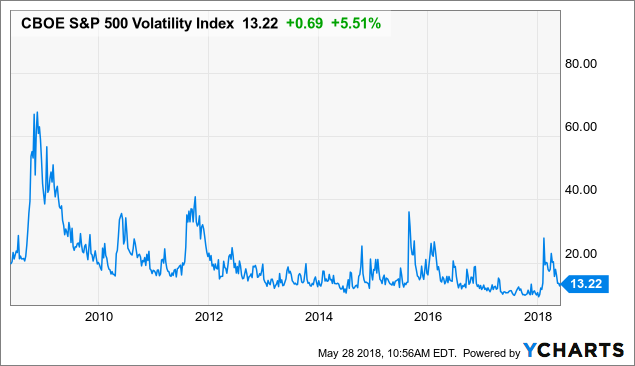
ABC Arbitrage EPS and distribution 2008 to 2017

Chart ^VIX data by YCharts

2008 was the company��s best year ever as the great financial crisis unfolded (net result was ��40.6m). The first half of 2009 was very volatile as well. In 2011, the Eurozone's public debt crisis also created a fair amount of volatility, which benefited the company. As volatility receded in subsequent years, trading profits decreased, and ABC Arbitrage suffered from withdrawals from external clients resulting in lower assets under management. 2015 and 2016 showed gradual improvement before 2017 and its record low volatility took their toll on EPS. Because the company decided to maintain high payout despite the weaker 2017 earnings, part of the distribution was treated as repayment of capital contributions.

With regards to tax treatment, the general French withholding tax rate is 30%; however, there is a tax treaty in place between France and the US that lowers the rate for US investors to 15%, and those 15% are deductible from the investor��s US tax return.

Insider ownership

CEO Dominique Ceolin owns 16% of the company (either directly or via his 50.01% owned holding company Financi猫re WDD); David HOEY (deputy CEO) owns 5%, other managers own close to 4%. In 2017, the CEO purchased ��681k worth of shares.

Risks to consider

Assets under management: in the outlook section of the 2017 annual report, the company signaled a decrease of AuM in early 2018, from ��434m as of end 2017 to ��384m as of March 1, 2018. Investors tend to get their timing wrong, leaving when volatility is low, and coming back when volatility has already returned. Withdrawals were probably the result of record low volatility in Q4, but I will be checking the next semi-annual report to see if the trend has reversed following the recent spike in volatility. Though external clients account for a lower share of revenue than proprietary trading, the company stated its intention to increase the size of AuM as part of the Step Up 2019 plan.

Technology risk: the company��s strategies rely on its proprietary algorithms. To remain competitive, ABC Arbitrage needs to keep its technological edge. The Step Up 2019 plan does include investments in technology. If, at some point, results did not respond to increasing volatility, that would be a warning sign.

Takeaways

It is no coincidence that ABC Arbitrage had its best year in 2008, in the heat of the financial crisis. The company is a good way to get long volatility, and the VIX can be considered a leading indicator for its performance. The shares are up 10% YTD, but do not look expensive given the improved conditions in Q1, and there is potential for further appreciation if volatility returns for good. 2018 earnings should be sufficient to cover and possibly increase the distribution of close to 5.8% at current price.

Of course, there is no guarantee that the share price would not take a hit during a market melt-down, as investors throw the baby out with the bathwater. However, price action in February 2018, when the shares reacted well to the return of volatility, tends to show that investors have understood what drives the company's performance.

The most important thing is that in a downturn, operational performance would be strong, and the distributions would be well-covered and possibly growing (as happened in 2008 and 2009). Along with Virtu and Flow Traders, I think that ABC Arbitrage brings an antifragile component to a well-diversified portfolio.

Disclosure: I am/we are long FLTDF, ABC Arbitrage.

I wrote this article myself, and it expresses my own opinions. I am not receiving compensation for it (other than from Seeking Alpha). I have no business relationship with any company whose stock is mentioned in this article.

Additional disclosure: The opinions and views expressed in this article are for information purposes only and should not be used or construed as an offer to sell, a solicitation of an offer to buy, or a recommendation to buy, sell or hold any security, investment strategy or market sector.


Monday, May 28, 2018

Brokerages Anticipate Cohu, Inc. (COHU) to Post $0.42 EPS

Equities research analysts expect Cohu, Inc. (NASDAQ:COHU) to report $0.42 earnings per share for the current quarter, according to Zacks. Two analysts have made estimates for Cohu’s earnings, with the highest EPS estimate coming in at $0.48 and the lowest estimate coming in at $0.32. Cohu reported earnings per share of $0.48 during the same quarter last year, which suggests a negative year over year growth rate of 12.5%. The business is scheduled to issue its next quarterly earnings results on Thursday, July 26th.

According to Zacks, analysts expect that Cohu will report full year earnings of $1.72 per share for the current financial year, with EPS estimates ranging from $1.67 to $1.75. For the next year, analysts expect that the company will post earnings of $2.03 per share, with EPS estimates ranging from $2.00 to $2.06. Zacks’ earnings per share averages are an average based on a survey of research analysts that that provide coverage for Cohu.

Get Cohu alerts:

Cohu (NASDAQ:COHU) last announced its earnings results on Tuesday, May 8th. The semiconductor company reported $0.36 EPS for the quarter, topping the Zacks’ consensus estimate of $0.33 by $0.03. Cohu had a return on equity of 14.10% and a net margin of 9.33%. The company had revenue of $95.20 million for the quarter, compared to analysts’ expectations of $93.07 million. During the same period last year, the firm earned $0.24 EPS. Cohu’s revenue for the quarter was up 17.4% compared to the same quarter last year.

A number of equities analysts recently commented on the company. BidaskClub raised Cohu from a “buy” rating to a “strong-buy” rating in a report on Saturday, May 12th. Dougherty & Co reaffirmed a “buy” rating on shares of Cohu in a report on Wednesday, February 21st. Stifel Nicolaus raised Cohu from a “hold” rating to a “buy” rating in a report on Tuesday, May 8th. Zacks Investment Research raised Cohu from a “sell” rating to a “buy” rating and set a $27.00 price target on the stock in a report on Wednesday, April 18th. Finally, ValuEngine raised Cohu from a “hold” rating to a “buy” rating in a report on Friday, February 2nd. One investment analyst has rated the stock with a hold rating, five have given a buy rating and one has issued a strong buy rating to the company’s stock. Cohu presently has a consensus rating of “Buy” and an average target price of $24.80.

In other Cohu news, Director William Bendush sold 3,000 shares of the firm’s stock in a transaction dated Thursday, May 17th. The stock was sold at an average price of $23.20, for a total transaction of $69,600.00. The transaction was disclosed in a legal filing with the SEC, which can be accessed through this link. 3.88% of the stock is owned by company insiders.

A number of large investors have recently bought and sold shares of COHU. BlackRock Inc. increased its holdings in shares of Cohu by 7.9% in the first quarter. BlackRock Inc. now owns 3,993,647 shares of the semiconductor company’s stock worth $91,096,000 after purchasing an additional 293,537 shares during the last quarter. Cooke & Bieler LP increased its holdings in shares of Cohu by 11.4% in the first quarter. Cooke & Bieler LP now owns 1,077,278 shares of the semiconductor company’s stock worth $24,573,000 after purchasing an additional 110,498 shares during the last quarter. Royce & Associates LP increased its holdings in shares of Cohu by 2.4% in the fourth quarter. Royce & Associates LP now owns 1,067,533 shares of the semiconductor company’s stock worth $23,432,000 after purchasing an additional 25,019 shares during the last quarter. Systematic Financial Management LP increased its holdings in shares of Cohu by 9.8% in the first quarter. Systematic Financial Management LP now owns 858,128 shares of the semiconductor company’s stock worth $19,574,000 after purchasing an additional 76,478 shares during the last quarter. Finally, Northern Trust Corp increased its holdings in shares of Cohu by 10.9% in the first quarter. Northern Trust Corp now owns 444,241 shares of the semiconductor company’s stock worth $10,133,000 after purchasing an additional 43,602 shares during the last quarter. 87.24% of the stock is currently owned by institutional investors and hedge funds.

Cohu stock traded down $0.20 during trading on Friday, reaching $24.24. The company had a trading volume of 376,670 shares, compared to its average volume of 405,018. Cohu has a 52 week low of $15.55 and a 52 week high of $26.17. The stock has a market cap of $703.83 million, a P/E ratio of 18.09, a P/E/G ratio of 2.01 and a beta of 0.96. The company has a debt-to-equity ratio of 0.02, a quick ratio of 3.00 and a current ratio of 3.81.

The firm also recently declared a quarterly dividend, which will be paid on Friday, July 27th. Shareholders of record on Friday, June 15th will be issued a dividend of $0.06 per share. The ex-dividend date is Thursday, June 14th. This represents a $0.24 dividend on an annualized basis and a yield of 0.99%. Cohu’s dividend payout ratio is presently 17.91%.

About Cohu

Cohu, Inc, through its subsidiaries, engages in the development, manufacture, sale, and servicing of semiconductor test and inspection handlers, micro-electro mechanical system (MEMS) test modules, test contactors, and thermal sub-systems for semiconductor manufacturers and test subcontractors worldwide.

Get a free copy of the Zacks research report on Cohu (COHU)

For more information about research offerings from Zacks Investment Research, visit Zacks.com

Sunday, May 27, 2018

Chevron, Exxon Tank the Dow Friday

May 25, 2018: Markets opened lower again Friday with the Dow and the S&P 500 trading in the red for the rest of the day. The Nasdaq broke into the green shortly after the bell but buying gave way to selling by late morning and the index now looks headed for no more than a basically flat close. The energy sector collapsed today, first on news of a possible increase in production from OPEC and its partners and then on a massive increase in the oil rig count.

WTI crude oil for July delivery closed at $67.88 a barrel, down about 4% for the day and down 4.9% for the week to its lowest level since May 1. June gold dropped less than 0.1%% on the day to settle at $1,303.70, but managed a gain of about 1% for the week. Equities were headed for a narrowly mixed close about 10 minutes before the bell as the Dow traded down 0.31% for the day, the S&P 500 traded down 0.33%, and the Nasdaq Composite traded up 0.03%.

Bitcoin futures (XBTM8) for June delivery traded at $7,390, down about 2.2% on the CBOE after opening at $7,540 this morning. The trading range today was $7,325 to $7,670.

The Dow stock posting the largest daily percentage loss ahead of the close Friday was Chevron Corp. (NYSE: CVX) which traded down 3.75% at $121.86. The stock’s 52-week range is $102.55 to $133.88. Volume was equal to the daily average of around 6.7 million shares. The company had no specific news, but tumbling oil prices hit shares hard.

Exxon Mobil Corp. (NYSE: XOM) traded down 2.16% at $78.54 in a 52-week range of $72.16 to $89.30. Volume was about 30% below the daily average of around 14.7 million shares. The company had no specific news, but then, none was necessary.

Caterpillar Inc. (NYSE: CAT) traded down 1.16% at $155.88. The stock’s 52-week range is $102.30 to $173.24. Volume was about 33% below the daily average of around 5.4 million. The company had no specific news Friday.

American Express Co. (NYSE: AXP) traded down 1.03% at $100.96. The stock’s 52-week range is $75.98 to $103.24. Volume was about 60% below the daily average of around 3.6 million. The company had no news Friday.

Of the Dow stocks, 11 are on track to close higher Friday and 19 are set to close lower.

24/7 Wall St.
The Biggest Company the Year You Were Born

Saturday, May 26, 2018

US Bancorp DE Boosts Position in Allegion (ALLE)

US Bancorp DE raised its stake in Allegion (NYSE:ALLE) by 6.1% in the 1st quarter, according to the company in its most recent disclosure with the Securities & Exchange Commission. The fund owned 45,018 shares of the scientific and technical instruments company’s stock after purchasing an additional 2,594 shares during the quarter. US Bancorp DE’s holdings in Allegion were worth $3,839,000 as of its most recent filing with the Securities & Exchange Commission.

Several other institutional investors also recently modified their holdings of the company. Tower Research Capital LLC TRC increased its position in shares of Allegion by 109.1% during the fourth quarter. Tower Research Capital LLC TRC now owns 1,326 shares of the scientific and technical instruments company’s stock valued at $105,000 after acquiring an additional 692 shares during the last quarter. Macquarie Group Ltd. bought a new position in Allegion during the fourth quarter valued at $111,000. Commerzbank Aktiengesellschaft FI bought a new position in shares of Allegion in the first quarter worth $205,000. FDx Advisors Inc. bought a new position in shares of Allegion in the first quarter worth $209,000. Finally, Zeke Capital Advisors LLC bought a new position in shares of Allegion in the fourth quarter worth $205,000. 87.87% of the stock is owned by hedge funds and other institutional investors.

Get Allegion alerts:

In other Allegion news, CFO Patrick S. Shannon sold 20,200 shares of the stock in a transaction dated Friday, March 9th. The shares were sold at an average price of $85.83, for a total transaction of $1,733,766.00. Following the completion of the transaction, the chief financial officer now owns 68,790 shares of the company’s stock, valued at approximately $5,904,245.70. The transaction was disclosed in a legal filing with the Securities & Exchange Commission, which can be accessed through the SEC website. Also, insider Douglas P. Ranck sold 10,480 shares of the stock in a transaction dated Thursday, March 8th. The shares were sold at an average price of $84.64, for a total transaction of $887,027.20. The disclosure for this sale can be found here. Insiders sold a total of 57,415 shares of company stock valued at $4,924,641 in the last ninety days. 0.75% of the stock is currently owned by insiders.

Several equities research analysts recently issued reports on the company. Imperial Capital reissued an “outperform” rating and set a $94.00 price objective (up previously from $85.00) on shares of Allegion in a research note on Wednesday, February 21st. Zacks Investment Research upgraded Allegion from a “hold” rating to a “strong-buy” rating and set a $99.00 price objective on the stock in a report on Thursday, February 22nd. Wells Fargo & Co reissued an “outperform” rating and issued a $105.00 target price (up from $100.00) on shares of Allegion in a research note on Wednesday, February 21st. Berenberg Bank cut Allegion from a “buy” rating to a “hold” rating in a research note on Wednesday, May 2nd. Finally, Barclays started coverage on Allegion in a research report on Thursday, February 15th. They set an “overweight” rating and a $100.00 price objective on the stock. Four analysts have rated the stock with a hold rating and four have assigned a buy rating to the company’s stock. The stock presently has an average rating of “Buy” and an average price target of $94.60.

Shares of Allegion stock opened at $78.79 on Friday. The firm has a market capitalization of $7.53 billion, a P/E ratio of 19.90, a PEG ratio of 1.38 and a beta of 1.07. The company has a quick ratio of 1.17, a current ratio of 1.78 and a debt-to-equity ratio of 3.20. Allegion has a fifty-two week low of $73.85 and a fifty-two week high of $89.81.

Allegion (NYSE:ALLE) last issued its earnings results on Thursday, April 26th. The scientific and technical instruments company reported $0.80 earnings per share for the quarter, missing the consensus estimate of $0.84 by ($0.04). The firm had revenue of $613.10 million during the quarter, compared to the consensus estimate of $605.47 million. Allegion had a return on equity of 102.62% and a net margin of 11.21%. The company’s quarterly revenue was up 11.7% on a year-over-year basis. During the same period in the prior year, the company posted $0.71 EPS. sell-side analysts forecast that Allegion will post 4.48 EPS for the current year.

The company also recently announced a quarterly dividend, which will be paid on Friday, June 29th. Investors of record on Friday, June 15th will be issued a $0.21 dividend. This represents a $0.84 annualized dividend and a yield of 1.07%. The ex-dividend date of this dividend is Thursday, June 14th. Allegion’s dividend payout ratio is currently 21.21%.

About Allegion

Allegion plc manufactures and sells mechanical and electronic security products and solutions worldwide. The company offers locks, locksets, portable locks, and key systems; door closers and exit devices; electronic security products and access control systems; time, attendance, and workforce productivity systems; doors and door frames; and other accessories.

Want to see what other hedge funds are holding ALLE? Visit HoldingsChannel.com to get the latest 13F filings and insider trades for Allegion (NYSE:ALLE).

Institutional Ownership by Quarter for Allegion (NYSE:ALLE)

Thursday, May 24, 2018

U.S. Starts Probe to Consider Tariffs on Car, Truck Imports

President Donald Trump’s administration has started an investigation into whether car and truck imports threaten national security, a move that could lead to new U.S. tariffs on foreign vehicles.

“Core industries such as automobiles and automotive parts are critical to our strength as a nation,” Trump said in a statement late Wednesday. An investigation would unfold under Section 232 of the 1962 Trade Expansion Act, the same clause the U.S. invoked in imposing global tariffs on imported steel and aluminum on the grounds they imperil U.S. security.

The administration is considering imposing an additional tariff on vehicles of up to 25 percent, according to a person familiar with the matter who asked not to be identified.

Imposing new duties on automobile imports may further inflame tensions with America’s biggest trading partners, adding to a series of U.S. threats that have roiled financial markets and upset traditional allies. The announcement comes as Republican lawmakers prepare for midterm elections in November that will determine whether the party retains its majority in both the House of Representatives and Senate.

#lazy-img-328003702:before{padding-top:56.25%;}

Trump has made protecting American manufacturing workers -- and the iconic auto industry, in particular -- a keystone of his administration. Wins in manufacturing states such as Michigan and Ohio were key to his victory in 2016.

Read more on the carmakers that would be hardest hit by an U.S. import crackdown

The auto-import probe was panned by open trade supporters.

“I fear that they’ve now crossed the Rubicon into wholesale protectionism.,” said Rufus Yerxa, president of the National Foreign Trade Council, a trade policy group representing U.S. companies. “Lots of countries have resorted to protectionism when their economies were doing badly. It almost never works. But Trump may be the first leader ever to do it when the economy is booming. He’s trying to fix a problem that ain’t broke. The auto industry is healthy.”

The Commerce Department, which is leading the probe, said in a statement that automobile manufacturing “has long been a significant source of American technological innovation.”

The investigation “will consider whether the decline of domestic automobile and automotive parts production threatens to weaken the internal economy of the United States, including by potentially reducing” everything from research and development to skilled jobs, and more advanced manufacturing processes like electric motors and autonomous vehicles, according to the Commerce department.

The department added it will publish a notice soon announcing a hearing date and inviting comment from businesses and the public.

Mexico, Canada

Mexico exports the most passenger cars to the U.S., followed by Canada, Japan, Germany and South Korea, according to U.S. data. Industry observers saw this latest move as a U.S. tactic to pressure Mexico and Canada to move quickly to agree to an overhaul the North American Free Trade Agreement. Rules for regional content in cars have been one of the major sticking points in the Nafta discussions.

Almost a quarter of autos sold in the U.S. are imported, according to government figures. The U.S. levies a 2.5 percent duty on imported passenger cars and a 25 percent tariff on pickup trucks from countries that are not parties to free trade agreements.

The Trump administration is already embroiled in trade disputes on a number of fronts.

The U.S. is in talks with China on a deal to avoid tit-for-tat tariffs between the world’s two biggest economies. In a tweet Wednesday morning, the president said a trade agreement with China may be “too hard to get done” and probably will require a “different structure.” Trump’s remarks damped expectations that the two sides may have reached a truce, after Treasury Secretary Steven Mnuchin said the U.S. had put its tariff plans "on hold."

China announced on Tuesday that it will cut the duty on passenger cars to 15 percent, from the current 25 percent, as of July 1.

‘Big News’

The president signaled earlier Wednesday on Twitter that an important announcement was imminent to help the U.S. car-manufacturing industry. “There will be big news coming soon for our great American Autoworkers. After many decades of losing your jobs to other countries, you have waited long enough!” Trump said in the tweet.

Section 232 gives the U.S. president the power to impose tariffs on imports that imperil national security. It has been used sparingly by previous administrations. It’s separate from the Section 301 investigation into China’s intellectual property practices, a clause in a 1974 trade law meant to protect U.S. industries from unfair competition.

Since the 2016 election campaign, Trump has repeatedly threatened to slap new tariffs on imported cars.

He revisited the possibility again on May 11, when he floated the idea of a 20 percent tariff on imported autos during a White House meeting with senior executives of 10 major automakers, a person familiar with the meeting said. He also suggested that imports should have to achieve tougher emissions standards than vehicles assembled in the U.S., the person said.

But it may be tougher for the U.S. to make a national security case with a consumer product such as cars, than it did with steel and aluminum, two materials used in military equipment.

— With assistance by Jenny Leonard

LISTEN TO ARTICLE 4:59 Share Share on Facebook Post to Twitter Send as an Email Print

Wednesday, May 23, 2018

Rio Tinto Is Ready to Accept $3.5 Billion Deal to Exit Grasberg

Rio Tinto Group is ready to accept a $3.5 billion deal with Indonesia for its interest in the giant Grasberg copper and gold mine, according to people with knowledge of the discussions.

A deal for Rio’s exit still depends on Freeport-McMoRan Inc. striking an agreement to transfer some of its stake to a local firm, according to the people, who asked not be identified because the matter is confidential. No deal has been signed and an agreement may still not be reached. Shares in Freeport surged on the news, while Rio pared a loss in New York Tuesday.

State-owned PT Indonesia Asahan Aluminium, known as Inalum, plans to acquire Rio’s joint venture interest in the operation under a wider arrangement aimed at taking control of Freeport’s local unit, said the people. PT Freeport Indonesia is the owner and operator of Grasberg, the world’s No. 2 copper mine.

Both Rio Tinto and Inalum declined to comment, while a spokesman for Freeport didn’t respond to a request for comment. Riza Pratama, a spokesman for PT-FI, said the company hopes to conclude negotiations by the end of June.

#lazy-img-327940404:before{padding-top:56.25%;}

Talks on the future of Grasberg have dragged on for more than a year as Freeport has sought to agree to terms to cede majority ownership, part of a deal that will allow the producer to keep operating in the country. Foreign miners have been given until 2019 to comply with divestment obligations imposed amid a push by President Joko Widodo’s government to exert more local control over the nation’s resources.

Rio, the world’s No. 2 miner, has been a partner in Grasberg since the 1990s under an agreement that helped Freeport finance an expansion. The London-based producer currently holds rights to a 40 percent share of output above specific levels, and had expected that to shift to 40 percent of all production from 2023, according to an April filing.

A tide of resource nationalism is causing miners to rethink where they invest, Rio Chief Executive Officer Jean-Sebastien Jacques said in a May 15 speech in Miami. The producer has flagged a strategy to continue to exit from unwanted operations, after agreeing to $5 billion worth of asset sales this year.

Freeport shares jumped as much as 6.5 percent in New York on Tuesday. They were up 3.6 percent at 3:43 p.m., while Rio’s U.S. shares were down 0.2 percent after falling as much as 0.7 percent earlier in the day.

— With assistance by Thomas Biesheuvel, Laura Millan Lombrana, Viriya Singgih, Yoga Rusmana, and Steven Frank

(Updates with shares in second and last paragraphs.) LISTEN TO ARTICLE 2:23 Share Share on Facebook Post to Twitter Send as an Email Print

Tuesday, May 22, 2018

Transocean: Well Positioned For Ultra-Deepwater Recovery

On Wednesday, May 16, 2018, offshore drilling giant Transocean (RIG) gave a presentation at the Citi Global Energy and Utilities Conference. While Transocean did spend a relatively small amount of time discussing the current conditions in the offshore drilling industry, the company devoted the majority of its efforts to discussing its own position in the industry as well as the methods that it has been using to weather the current downturn. Overall, the company has been handling the industry weakness quite well and will likely be positioned well when it finally recovers.

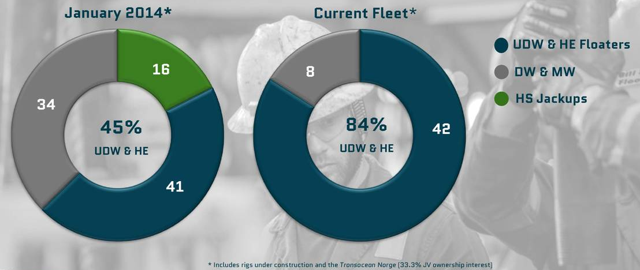
Transocean has long boasted one of the largest fleets in the offshore drilling industry, a status that it continues to hold to this date. With that said though, the company has somewhat changed the composition of its fleet over the course of the current downcycle. Here we see Transocean's fleet composition in January 2014 and today:

Source: Transocean

The current downcycle roughly began in the fourth quarter of 2013 so this does give us a good high-level overview of how the company has modified its fleet. As we can see here, when the downturn began, Transocean's fleet consisted of a combination of ultra-deepwater floaters, harsh-environment floaters, mid- and deepwater floaters, and high-specification jackup rigs. Since that time, the company has disposed of all of its shallow-water units and the majority of its mid- and deepwater units. The fleet shrunk substantially in the process.

This will likely prove to be a shrewd move for the company. As I have mentioned in numerous past articles, the exploration and production companies that make up the customers for the industry have been expressing a marked preference for securing the services of modern technically-sophisticated rigs. This has been true even throughout the downcycle, although the number of contracts being awarded was significantly lower than earlier this decade. As a general rule, most of the floating rigs that fall into this category are ultra-deepwater units. Midwater and deepwater rigs are generally older and certainly less capable than ultra-deepwater units. Thus, Transocean has streamlined its fleet to include the rigs that its customers are most interested in while reducing its deadweight, so to speak.

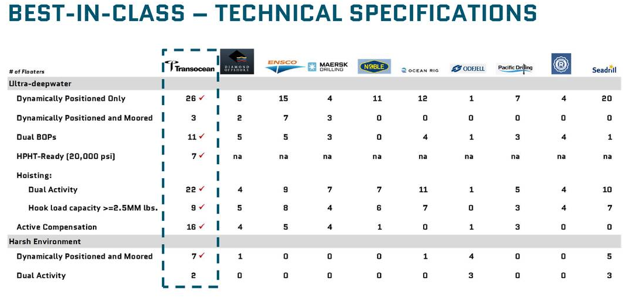
Transocean points this out in its presentation. As a direct result of the improvements that the company has been making to its fleet, it currently boasts the most advanced one in the industry.

Source: Transocean

Here we see that Transocean has more rigs with the features that customers have expressed interest or desire for than any of its major peers. The majority of these are items that will allow the rig to perform drilling operations in some of the demanding conditions that have become commonplace in today's market or safety equipment that reduces the risk of either worker injuries (and the ensuing costs) or the risk of oil spills and similar mishaps. This provides a competitive advantage for Transocean compared to its peers as it increases the likelihood that the company will have a rig available to meet the needs of a specific contract. Although this alone does not guarantee that the company will always win a contract, the chance is certainly increased.

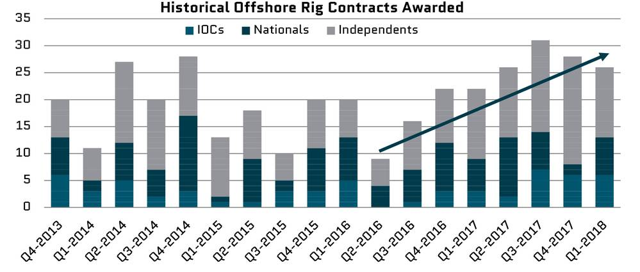
It is not exactly a secret that the ultra-deepwater segment of the industry has been struggling significantly over the past few years. this makes some sense. The downturn was originally precipitated by numerous exploration and production companies having strained cash flow due to high drilling costs, a problem that was exacerbated when oil prices collapsed in the middle of 2014. As ultra-deepwater rigs are by far the most costly type to operate and typically carried much longer contract terms than their shallow-water cousins, it makes sense that oil companies looking to save money would cut back on tendering ultra-deepwater rigs. Fortunately, that trend has begun to change since the beginning of 2017.

Source: Transocean, IHS Markit

As we see here, the world's exploration and production companies are awarding significantly more floater contracts today than they were in 2015 or 2016, although the level is down slightly this year but this could be an effect of the harsh winter. It still bodes well for Transocean going forward however since a higher level of contract awards should result in the company's unemployed rigs receiving more contracts, which should improve Transocean's revenues and cash flows going forward.

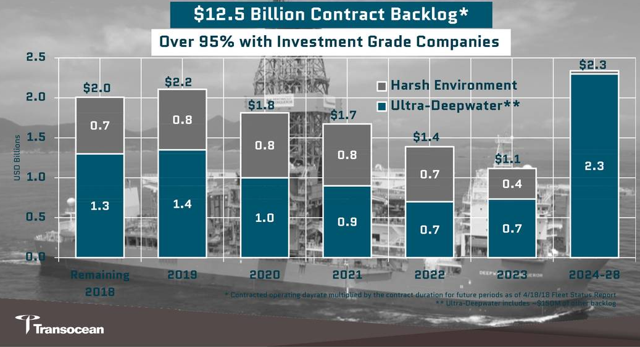
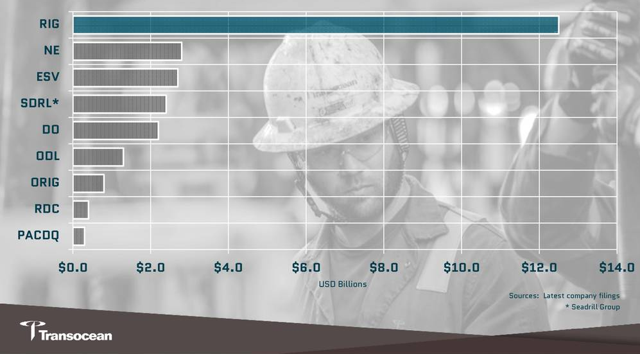
Transocean has already begun to see some benefits from this nascent recovery in the industry. As we see here, Transocean boasts an impressive $12.5 billion backlog:

Source: Transocean

This backlog is more than four times that of any of its nearest competitors.

Source: Transocean

A company's contract backlog is very important to an offshore drilling company. This is because it represents guaranteed revenues or at least as close as we can get to guaranteed in the industry as these future revenues are backed by contracts that the company has today. Thus, as investors we can use the company's backlog to get some idea of what a firm's forward revenues will look like. Here we can see that Transocean will bring in approximately $2.0 billion over the remainder of this year and $2.2 billion next year, with the amount steadily declining after that. It is worth noting that this is based on the company's current contracts so any new ones that it gets awarded will necessarily add to the amounts shown above.

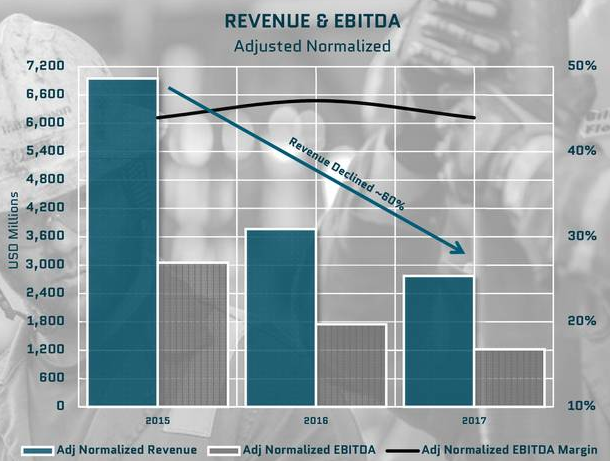
Of course, as investors we are mostly concerned with a company's ability to turn its revenues into cash flow. Fortunately, Transocean has been able to accomplish this, even through the industry downturn. Here we see Transocean's revenue and EBITDA over the past three years:

Source: Transocean

As we can see here, Transocean's revenue declined 60% over the 2015 to 2017 period. Despite the decline, the company managed to convert its revenue into positive EBITDA in each of the three years, although it did understandably decline with the company's revenues. This is something that should clearly please investors as it shows that the company is able to generate profits for its owners in any market environment as the 2015 to 2017 period was one of the worst downcycles ever suffered by the industry.

One of the biggest disadvantages of Transocean's streamlined fleet structure is the absence of any shallow-water capability. As I explained in a recent article, the shallow-water market typically recovers significantly earlier than the ultra-deepwater sector and in fact this has happened over the past year. This is because the jack-up rigs that perform the drilling operations in this sector carry much lower dayrates than ultra-deepwater floating rigs. They also historically had shorter contract durations than their larger cousins, although that has changed somewhat in the past several months. In short though, shallow-water rigs represent less of a financial commitment than ultra-deepwater units. The lack of any of these rigs in its fleet will thus prevent Transocean from taking advantage of new opportunities in this sector and may slow its revenue recovery compared to some of its peers that possess jack-up rigs, such as Rowan Companies (RDC).

In conclusion, Transocean has done an admirable job weathering the industry downcycle. The company has streamlined and high-graded its fleet, which should position it well to take advantage of the eventual recovery in the ultra-deepwater industry while its large backlog should ensure that the company is able to produce cash flow for its investors while this story plays out. The company will, however, likely take longer to recover than some of its peers due to the absence of shallow-water units in its fleet.

Disclosure: I/we have no positions in any stocks mentioned, and no plans to initiate any positions within the next 72 hours.

I wrote this article myself, and it expresses my own opinions. I am not receiving compensation for it (other than from Seeking Alpha). I have no business relationship with any company whose stock is mentioned in this article.

Sunday, May 20, 2018

Luminex Co. Announces Quarterly Dividend of $0.06 (LMNX)

Luminex Co. (NASDAQ:LMNX) announced a quarterly dividend on Friday, May 18th, RTT News reports. Shareholders of record on Friday, June 22nd will be given a dividend of 0.06 per share by the medical instruments supplier on Friday, July 13th. This represents a $0.24 dividend on an annualized basis and a yield of 0.88%.

Luminex opened at $27.20 on Friday, according to Marketbeat. Luminex has a 12-month low of $18.62 and a 12-month high of $27.24. The firm has a market cap of $1.17 billion, a PE ratio of 29.89, a PEG ratio of 2.17 and a beta of 0.11.

Get Luminex alerts:

Luminex (NASDAQ:LMNX) last posted its quarterly earnings results on Monday, May 7th. The medical instruments supplier reported $0.30 earnings per share (EPS) for the quarter, topping analysts’ consensus estimates of $0.22 by $0.08. Luminex had a return on equity of 8.07% and a net margin of 10.60%. The business had revenue of $82.60 million for the quarter, compared to the consensus estimate of $80.52 million. During the same quarter in the prior year, the company earned $0.28 EPS. The business’s revenue was up 6.2% compared to the same quarter last year. research analysts forecast that Luminex will post 0.75 earnings per share for the current fiscal year.

A number of research firms have recently issued reports on LMNX. BidaskClub raised Luminex from a “buy” rating to a “strong-buy” rating in a research report on Thursday, April 19th. BTIG Research set a $26.00 price target on Luminex and gave the stock a “buy” rating in a research report on Tuesday, May 8th. ValuEngine raised Luminex from a “hold” rating to a “buy” rating in a research report on Tuesday, May 8th. Deutsche Bank raised Luminex from a “sell” rating to a “hold” rating and set a $22.00 price target on the stock in a research report on Monday, May 7th. Finally, William Blair reissued a “market perform” rating on shares of Luminex in a research report on Tuesday, February 13th. Four research analysts have rated the stock with a hold rating and three have issued a buy rating to the company. The company currently has a consensus rating of “Hold” and a consensus price target of $24.00.

In related news, SVP Todd C. Bennett sold 2,235 shares of the firm’s stock in a transaction dated Monday, May 14th. The stock was sold at an average price of $25.95, for a total transaction of $57,998.25. Following the sale, the senior vice president now owns 21,309 shares of the company’s stock, valued at $552,968.55. The sale was disclosed in a filing with the SEC, which is available through the SEC website. 7.40% of the stock is owned by company insiders.

About Luminex

Luminex Corporation develops, manufactures, and sells proprietary biological testing technologies and products for the diagnostics, pharmaceutical, and research industries worldwide. Its products include Luminex 100/200 that integrates fluidics, optics, and digital signal processing; FLEXMAP 3D system for use as a general laboratory instrument; MAGPIX system, a multiplexing analyzer for qualitative and quantitative analysis of proteins and nucleic acids; ARIES system, a sample to answer real-time PCR platform; ARIES M1 system, a single-module version of the ARIES System; and VERIGENE system, an automated multiplex-capable system.

Dividend History for Luminex (NASDAQ:LMNX)

FDA Shame List: 40 Drug Makers That Try to Block Generic Drugs

The Food and Drug Administration (FDA) announced a shame list of companies that try to block generic drugs in order to ramp up profits.

FDAPharmaceutical companies argue that they spend billions of dollars to research and develop new drugs, which they don’t want competitors profiting from by making cheaper generic copies of these medicines. These companies often fight for patent extensions, seek new uses for old products and sometimes prevent generic drug companies from obtaining samples.

Here are the 40 companies that made the FDA’s list:

Ranbaxy Laboratories Sun Pharmaceutical Industries Limited Galena Biopharma, Inc. Roche Palo Alto, LLC Bayer AG Novartis AG (ADR) (NYSE:NVS) Mylan NV (NASDAQ:MYL) Acorda Therapeutics Inc (NASDAQ:ACOR) AstraZeneca plc (ADR) (NYSE:AZN) Teva Pharmaceutical Industries Ltd (ADR) ADR (NYSE:TEVA) HLS Therapeutics, Inc Orphan Europe SARL King Pharmaceuticals Inc. Cubist Pharmaceuticals Jazz Pharmaceuticals PLC (NASDAQ:JAZZ) Cephalon (MM) ApoPharma Inc Shire Plc NPS Pharmaceuticals Inc Boehringer Ingelheim GmbH Questcor Pharmaceuticals Inc Pharmacia & Upjohn Inc Aegerion Pharmaceuticals Inc (NASDAQ:AEGR) Corcept Therapeutics Incorporated (NASDAQ:CORT) BioMarin Pharmaceutical Inc. (NASDAQ:BMRN) Gilead Sciences, Inc. (NASDAQ:GILD) Roxane Laboratories, Inc. Danco Laboratories LLC Meda Pharmaceuticals Inc Actelion Ltd. Swedish Orphan Biovitrum AB Celgene Corporation (NASDAQ:CELG) GlaxoSmithKline plc (ADR) (NYSE:GSK) VIVUS, Inc. (NASDAQ:VVUS) Hyperion Therapeutics Inc H. Lundbeck A/S Insys Therapeutics Inc (NASDAQ:INSY) Biogen Inc (NASDAQ:BIIB) Pfizer Inc. (NYSE:PFE) Valeant Pharmaceuticals Intl Inc (NYSE:VRX) Compare Brokers